
OUR PRODUCTS
KloverCloud Multi-Kubernetes Cluster Management
KloverCloud has a dedicated platform which has a intuitive control plane for managing Kubernetes objects across multiple Kubernetes Clusters. KC platform agent gets deployed to each Kubernetes cluster which listens to Kubernetes events and send objects data to the platform control plane. This dedicated control plane can read/write/update/delete Kubernetes objects and events across multiple Kubernetes clusters through KC agent.
This multi-cluster capability is essential for organizations operating at scale, ensuring consistent and efficient operations. The platform aims to simplify and centralize Kubernetes cluster management, providing robust functionality for DevOps teams and system administrators.
Cluster Onboarding
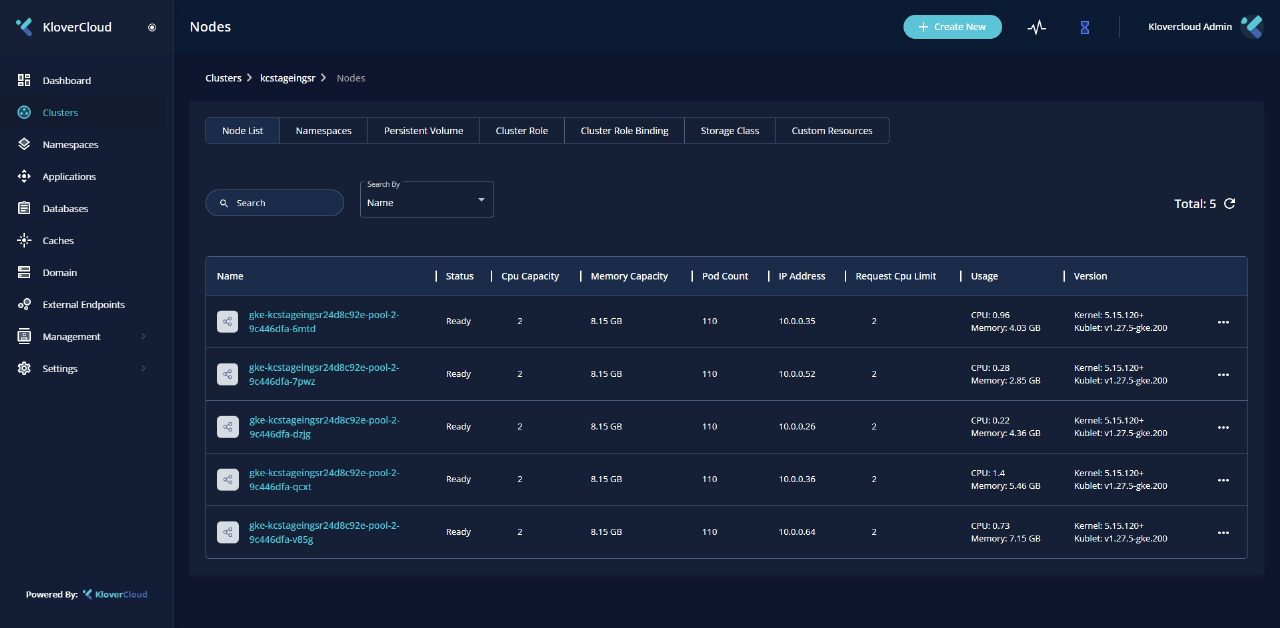
Users can connect any Kubernetes cluster with the KloverCloud console. By which users can manage multi-Kubernetes clusters from a single control plane. KloverCloud team will provide an operator to onboard the cluster with the KloverCloud console.
Cluster onboarding involves configuring nodes to join the cluster, setting up networking and security parameters, and ensuring compatibility with the existing infrastructure. KC Operator ensures proper onboarding practices include adherence to security standards, and verifying that nodes are in healthy states within the cluster.
Traffic Management through Control Plane UI
KC Multi-Kubernetes Cluster Management Platform provides a comprehensive cluster monitoring dashboard by which users can monitor the cluster resources like CPU, Memory, Disk (Usage, Capacity), network in and out, and request per second etc. The system will generate an alert in a specific channel by its alerting threshold.There will be multiple dashboards like:
- Namespace wise resources
- Node wise resources
- POD wise usage
Cluster Upgrade
From the KC Multi-Kubernetes Cluster Management Platform, security patches and Kubernetes versions can be upgraded pretty easily. Kubernetes cluster upgrades are essential for ensuring security by applying the latest patches, addressing vulnerabilities, and maintaining compliance. Upgrades also deliver new features, optimizations, and bug fixes, enhancing performance, stability, and overall cluster reliability. Regular upgrades align the cluster with the evolving Kubernetes ecosystem, providing organizations with access to community support, updated documentation, and compatibility with the latest tools and integrations.
Cluster Certificate Renewal
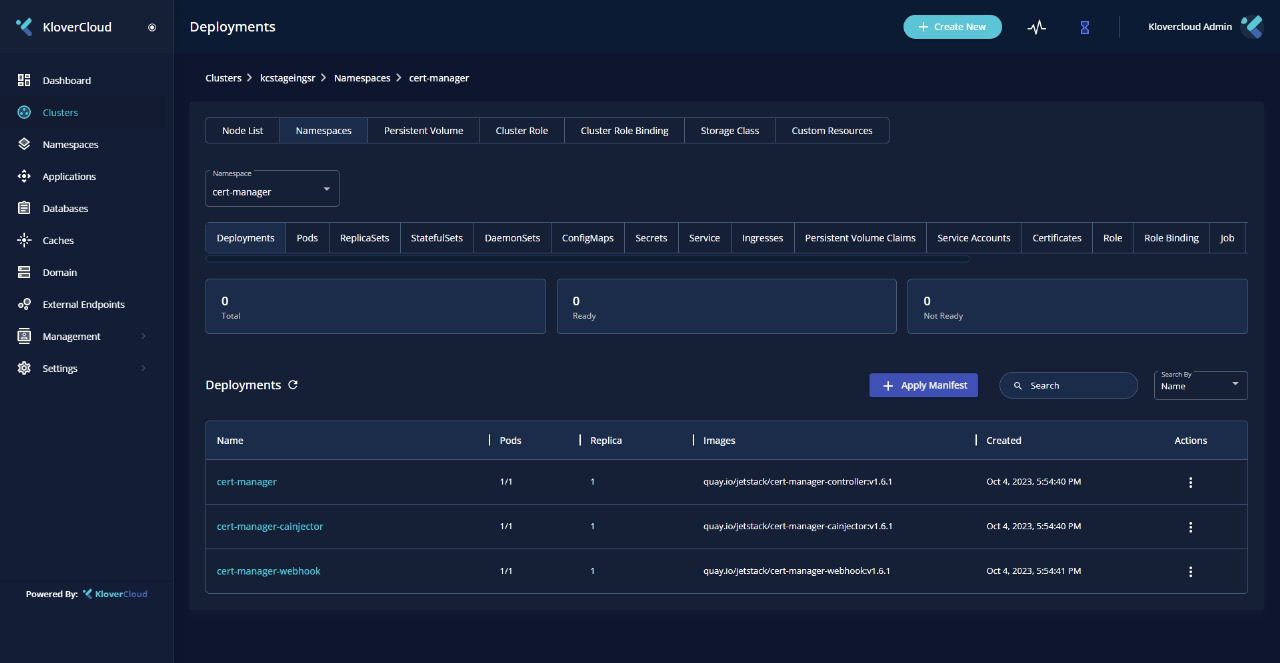
Cluster Certificate Renewal is a process of updating or renewing the security certificates used within a Kubernetes cluster. These certificates are essential for securing communication and authentication between various components of the cluster, such as nodes, control plane components, and the API server. Through the KC Multi-Kubernetes Cluster Management Platform any type of certificate can be upgraded including a custom certificate. This process is crucial for maintaining the security and integrity of the cluster, as certificates expire over time. During the upgrade, certificates are renewed and distributed to relevant components, ensuring secure communication and authentication within the Kubernetes cluster.
Cluster Node Cordon
Kubernetes cordon is an operation that marks or taints a node in your existing node pool as unschedulable. By using it on a node, you can be sure that no new pods will be scheduled for this node. The command prevents the Kubernetes scheduler from placing new pods onto that node, but it doesn’t affect existing pods on that node. Kubernetes cordon and drain prepare your application for node downtime by letting workloads running on a target node get rescheduled to other ones. You can then safely shut the node down and remove it from your cluster, confident that this doesn’t impact service availability in any way. Through KC Multi-Kubernetes Cluster Management Platform cordoning nodes are easier.
Cluster Node Taint
In Kubernetes, a Cluster Node Taint is a configuration that marks a node with certain characteristics, restricting the types of workloads that can be scheduled on it. Taints are used to influence the scheduling decisions of the Kubernetes control plane, preventing certain pods from running on nodes unless they tolerate or match the specified taints. This mechanism allows administrators to enforce policies, such as reserving specific nodes for specialized workloads or isolating nodes with particular hardware features.
Kubernetes Resource Management
Kubernetes Resource Management involves the CRUD operations: Create, Read, Update, and Delete, for efficiently handling computing resources. "Create" involves defining and deploying resources like pods and services, "Read" allows monitoring and querying resource status, "Update" facilitates adjusting configurations dynamically, and "Delete" manages the decommissioning of resources. This CRUD cycle is fundamental to Kubernetes declarative approach, empowering users to manage containerized applications and infrastructure in a scalable and automated manner. Through KC Multi-Kubernetes Cluster Management Platform, resources of Kubernetes can be created, updated, deleted, and listed.
KloverCloud Managed K8s On Bare Metal
Managed kubernetes includes a production grade kubernetes setup with all the necessary management & monitoring tools along with 24/7 support. Having a fully managed kubernetes with distributed storage & an automated DevOps platform, it can be treated as your very own private cloud. So now you can focus more on your business and let KloverCloud take care of your Kubernetes Cluster Administration & Management.
Our fully managed Kubernetes solutions offer seamless deployment, scaling, and management of your containerized applications with the reliability and performance you need to drive your business forward.
Highly Available Kubernetes Components
Klovercloud ensures the high availability of important Kubernetes components like etcd, api-server. Regular backup and restoring assures quick emergency response.
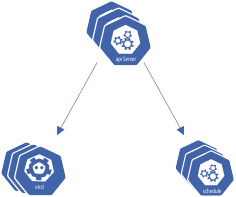
Highly Available K8s components
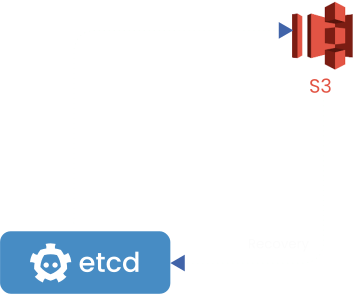
ETCD auto backup and restore

Ceph as Distributed Storage
Enjoy block, blob and object storage facility with high availability in your on-premise cluster.

Calico and Cilium as CNI
KloverCloud offers Calico and Cilium as your Container Network Interface.
Monitoring Matrix and Log Aggregation
Helps developers to focus on business problem instead of managing operation. Easy customization and powerful UI features accelerate seamless cloud journey.

Promethues

Graphana Loki

Graphana
Others
Use MetalLB as load balancer, Istio as service mesh, KubeVirt as virtualization add-on to Kubernetes, Nginx and Cilium as ingress controller and so on.

MetalLB as L4 Load balancer
MetalLB is a load-balancer implementation for bare metal Kubernetes clusters, using standard routing protocols.
KubeVirt as virtualization add-on to Kubernetes
KubeVirt addresses the needs of development teams that have adopted or want to adopt Kubernetes but possess existing Virtual Machine-based workloads that cannot be easily containerized.
Istio as Service mesh
Istio extends Kubernetes to establish a programmable, application-aware network using the powerful Envoy service proxy.